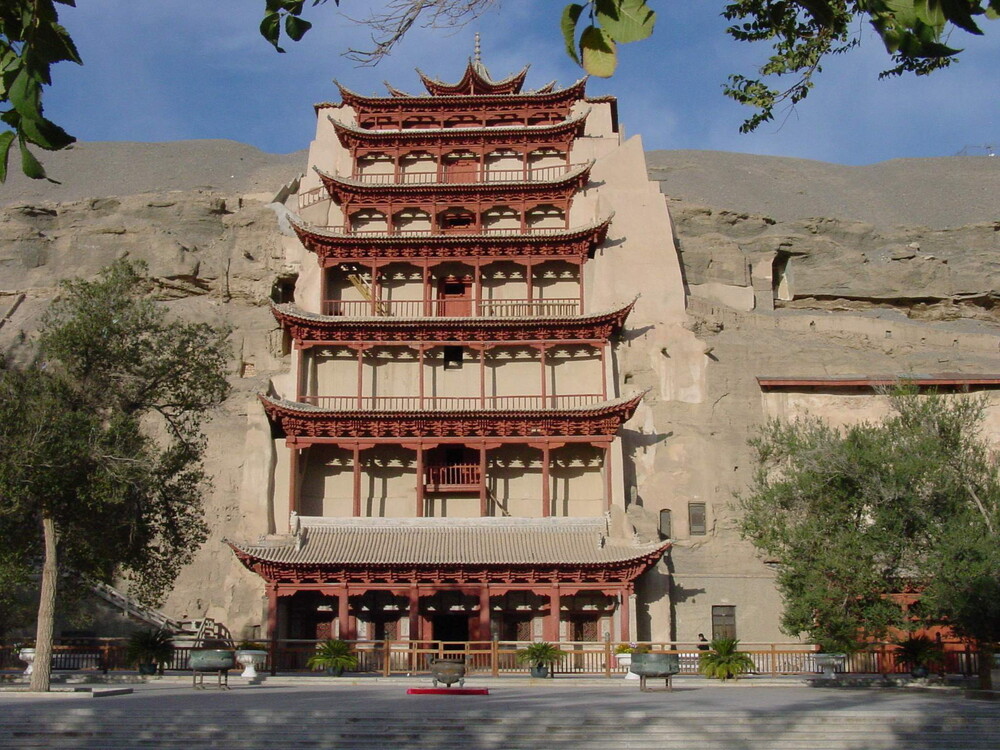
Brief Description
Situated at a strategic point along the Silk Route, at the crossroads of trade as well as religious, cultural and intellectual influences, the 492 cells and cave sanctuaries in Mogao are famous for their statues and ...
Outstanding Universal Value - Brief Synthesis
Carved into the cliffs above the Dachuan River, the Mogao Caves south-east of the Dunhuang oasis, Gansu Province, comprise the largest, most richly endowed, and longest used treasure house of Buddhist art in the world. It was first constructed in 366AD and represents the great achievement of Buddhist art from the 4th to the 14th century. 492 caves are presently preserved, housing about 45,000 square meters of murals and more than 2,000 painted sculptures. Cave 302 of the Sui dynasty contains one of the oldest and most vivid scenes of cultural exchanges along the Silk Road, depicting a camel pulling a cart typical of trade missions of that period. Caves 23 and 156 of the Tang dynasty show workers in the fields and a line of warriors respectively and in the Song dynasty Cave 61, the celebrated landscape of Mount Wutai is an early example of artistic Chinese cartography, where nothing has been left out – mountains, rivers, cities, temples, roads and caravans are all depicted.
As evidence of the evolution of Buddhist art in the northwest region of China, the Mogao Caves are of unmatched historical value. These works provide an abundance of vivid materials depicting various aspects of medieval politics, economics, culture, arts, religion, ethnic relations, and daily dress in western China. The unique artistic style of Dunhuang art is not only the amalgamation of Han Chinese artistic tradition and styles assimilated from ancient Indian and Gandharan customs, but also an integration of the arts of the Turks, ancient Tibetans and other Chinese ethnic minorities. Many of these masterpieces are creations of an unparalleled aesthetic talent.
The discovery of the Library Cave at the Mogao Caves in 1900, together with the tens of thousands of manuscripts and relics it contained, has been acclaimed as the world’s greatest discovery of ancient Oriental culture. This significant heritage provides invaluable reference for studying the complex history of ancient China and Central Asia.
Criteria (i): The group of caves at Mogao represents a unique artistic achievement both by the organization of space into 492 caves built on five levels and by the production of more than 2,000 painted sculptures, and approximately 45,000 square meters of murals, among which are many masterpieces of Chinese art.
Criteria (ii): For 1,000 years, from the period of the Northern Wei Dynasty (386-534) to the Mongol-led Yuan Dynasty (1276-1386), the caves of Mogao played a decisive role in artistic exchanges between China, Central Asia and India.
Criteria (iii): The paintings at Mogao bear exceptional witness to the civilizations of ancient China during the Sui, Tang and Song dynasties.
Criteria (iv): The Thousand-Buddha Caves constitute an outstanding example of a Buddhist rock art sanctuary.
Criteria (v): Occupied by Buddhist monks from the end of the 19th century up to 1930, the rock art ensemble at Mogao, administered by the Dunhuang Cultural Relics Research Institute, preserves the example of a traditional monastic settlement.
Criteria (vi): The caves are strongly linked to the history of transcontinental relations and of the spread of Buddhism throughout Asia. For centuries the Dunhuang oasis, near which the two branches of the Silk Road forked, enjoyed the privilege of being a relay station where not only merchandise was traded, but ideas as well, exemplified by the Chinese, Tibetan, Sogdian, Khotan, Uighur and even Hebrew manuscripts found within the caves.