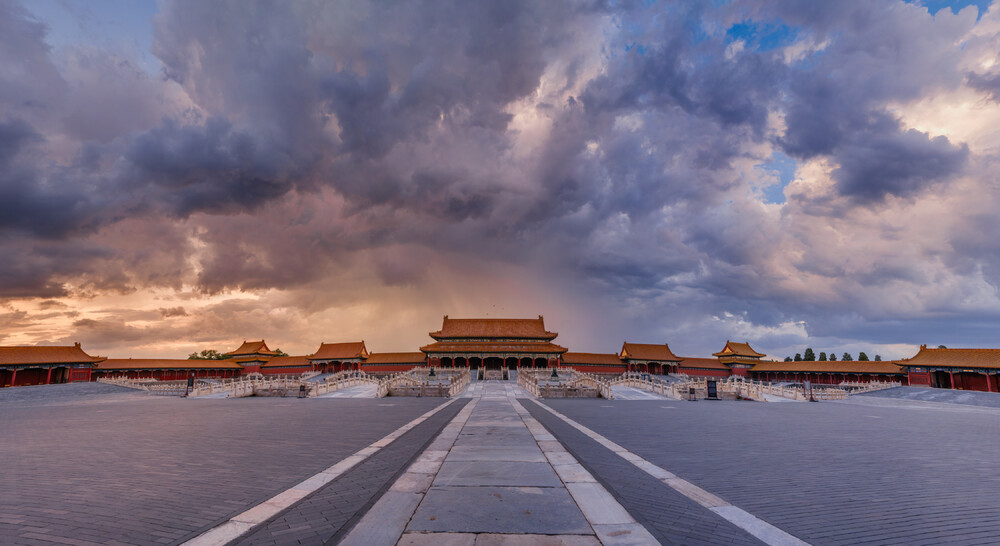
Brief Description
Seat of supreme power for over five centuries (1416-1911), the Forbidden City in Beijing, with its landscaped gardens and many buildings (whose nearly 10,000 rooms contain furniture and works of art), constitutes a ...
Outstanding Universal Value - Brief Synthesis
As the royal residences of the emperors of the Ming and Qing dynasties from the 15th to 20th century, the Imperial Palaces of the Ming and Qing dynasties in Beijing and Shenyang were the centre of State power in late feudal China. The Imperial Palace of the Ming and Qing Dynasties in Beijing known as the Forbidden City was constructed between 1406 and 1420 by the Ming emperor Zhu Di and witnessed the enthronement of 14 Ming and 10 Qing emperors over the following 505 years. The Imperial Palace of the Qing Dynasty in Shenyang was built between 1625 and 1637 by Nurgaci for the Nuzhen/Manchu forebears of the Qing Dynasty, which established itself in Beijing in 1644. Also known as Houjin Palace or Shenglin Palace, it was then used as the secondary capital and temporary residence for the royal family until 1911. The Imperial Palaces of Beijing and Shenyang were inscribed on the World Heritage List in 1987 and 2004 respectively.
The Forbidden City, located in the centre of Beijing is the supreme model in the development of ancient Chinese palaces, providing insight into the social development of late dynastic China, especially the ritual and court culture. The layout and spatial arrangement inherits and embodies the traditional characteristic of urban planning and palace construction in ancient China, featuring a central axis, symmetrical design and layout of outer court at the front and inner court at the rear and the inclusion of additional landscaped courtyards deriving from the Yuan city layout. As the exemplar of ancient architectural hierarchy, construction techniques and architectural art, it influenced official buildings of the subsequent Qing dynasty over a span of 300 years. The religious buildings, particularly a series of royal Buddhist chambers within the Palace, absorbing abundant features of ethnic cultures, are a testimony of the integration and exchange in architecture among the Manchu, Han, Mongolian and Tibetan since the 14th century. Meanwhile, more than a million precious royal collections, articles used by the royal family and a large number of archival materials on ancient engineering techniques, including written records, drawings and models, are evidence of the court culture and law and regulations of the Ming and Qing dynasties.
The Imperial Palace of the Qing Dynasty in Shenyang while following the traditions of palace construction in China retains typical features of traditional folk residences of the Manchu people, and has integrated the architectural arts of Han, Manchu and Mongolian ethnic cultures. The buildings were laid out according to the “eight-banner” system, a distinct social organization system in Manchu society, an arrangement which is unique among palace buildings. Within the Qingning Palace the sacrificial places for the emperors testify to the customs of Shamanism practiced by the Manchu people for several hundred years.