Brief Description
South China Karst is one of the world’s most spectacular examples of humid tropical to subtropical karst landscapes. It is a serial site spread over the provinces of Guizhou, Guangxi, Yunnan and Chongqing and covers ...
Outstanding Universal Value - Brief Synthesis
The huge karst area of South China is about 550,000 km2 in extent. The karst terrain displays a geomorphic transition as the terrain gradually descends about 2000 meters over 700 kilometers from the western Yunnan-Guizhou Plateau (averaging 2100 meters elevation) to the eastern Guangxi Basin (averaging 110 meters elevation). The region is recognized as the world’s type area for karst landform development in the humid tropics and subtropics.
The World Heritage Property of South China Karst is a serial property that includes seven karst clusters in four Provinces: Shilin Karst, Libo Karst, Wulong Karst, Guilin Karst, Shibing Karst, Jinfoshan Karst, and Huanjiang Karst. The total area is 97,125 hectares, with a buffer zone of 176,228 hectares. The property was inscribed in two phases.
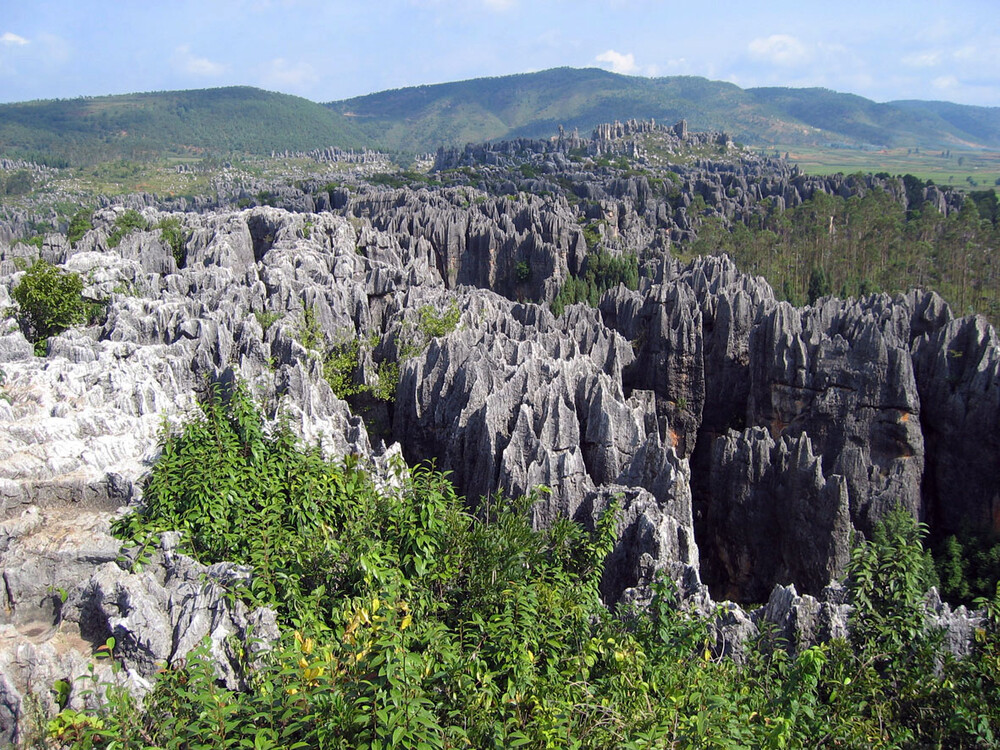
Phase I inscribed in 2007, include three clusters totalling 47,588 hectares, with buffer zones totalling 98,428 hectares. The Shilin Karst component is in Yunnan province and contains stone forests with sculpted pinnacle columns and is considered the world reference site for pinnacle karst. Shilin Karst consists of two core areas surrounded by a common buffer zone. The area is 12,070 hectares with a buffer zone of 22,930 hectares. The buffer zone is designated as a UNESCO Geopark. The Libo Karst component is in Guizhou province and includes high conical karst peaks, intervening deep enclosed depressions (cockpits), sinking streams and long underground caves. The area is considered a world reference site for cone karst. The property consists of two core areas surrounded by a common buffer. The area is 29,518 hectares with a buffer zone of 43,498 hectares. One of the components is a national nature reserve. The Wulong Karst component is in Chongqing province and consists of high inland karst plateaux that have experienced considerable uplift. Its giant dolines and bridges are representative of South China’s tiankeng (giant collapse depression) landscapes, and provide the evidence for the history of one of the world’s great river systems, the Yangtze and its tributaries. The Wulong Karst component is a cluster of three core zones, each with a separate buffer zone. The areas total 6,000 hectares with buffer zones of 32,000 hectares.
Phase II inscribed in 2014 includes four clusters totaling 49,537 hectares, and buffer zones totaling 77,800 hectares. The Guilin Karst component in Guangxi province is located within Lijiang National Park and contains fenglin (tower) and fengcong (cone) karst formations. Guilin Karst is divided into two sections: the Putao Section with an area of 2,840 hectares and a buffer zone of 21,610 hectares and the Lijiang Section with an area of 22,544 hectares and a buffer zone of 23,070 hectares. The Shibing Karst component in Guizhou province includes dolomitic karst formations and is located within Wuyanghe National Park. Shibing Karst has an area of 10,280 hectares and a buffer zone of 18,015 hectares. The Jinfoshan Karst component is a unique karst table mountain surrounded by towering cliffs. Jinfoshan Karst is located in Chongqing province within the boundaries of the Jinfoshan National Nature Reserve and Jinfoshan National Park. The Jinfoshan component has an area of 6,744 hectares and a buffer zone of 10,675 hectares. The Huanjiang Karst component is a cone karst area located in Guangxi Province within the boundaries of the Mulun National Nature Reserve. The Huanjiang Component has an area of 7,129 hectares and a buffer zone of 4,430 hectares.
The South China Karst World Heritage property protects a diversity of spectacular and iconic continental karst landscapes, including tower karst (fenglin), pinnacle karst (shilin) and cone karst (fengcong), as well as other karst phenomena such as Tiankeng karst (giant dolines), table mountains and gorges. The property also includes many large cave systems with rich speleothem deposits. The karst features and geomorphological diversity of the South China Karst are widely recognized as among the best in the world. The region can be considered the global type-site for three karst landform styles: fenglin (tower karst), fengcong (cone karst), and shilin (stone forest or pinnacle karst).The landscape also retains most of its natural vegetation, which results in seasonal variations and adds to the outstanding aesthetic value of the area.
The property contains the most spectacular, scientifically significant and representative series of karst landforms and landscapes of South China from interior high plateau to lowland plains and constitutes the world’s premier example of humid tropical to subtropical karst: one of our planet’s great landscapes. It complements sites that are also present in neighbouring countries, including Viet Nam, where several World Heritage properties also exhibit karst formations.